
Beyond the Mirror: How Chronic Cortisol Reshapes Your Face, Body, and Energy
Cortisol is often cast as the villain in wellness circles, but it’s actually a vital survival tool designed to help you handle immediate threats. The problem arises when that "alarm" never turns off. When stress becomes your baseline, cortisol stays elevated, leaving behind distinct physical patterns that no amount of expensive skincare or "grinding harder" can fix.
I remember the exact moment I realized my body was in a cortisol loop. It was during the height of my divorce, after I’d found out about my ex-husband and my friend. I was trying to "fix" myself by doing double workouts and eating almost nothing, but I looked more tired and bloated than ever. My face was puffy, my stomach felt permanently distended, and I was wide awake at 3:00 AM. I didn't realize that my body wasn't failing me—it was just trying to survive the internal emergency I was in.
The "Cortisol Face": Why Skincare Isn't Working
Chronically high cortisol levels wreak havoc on your fluid balance and tissue repair. On the face, this often shows up as a specific kind of puffiness around the eyes and jawline that seems to fluctuate for no clear reason. Because cortisol increases sodium retention and interferes with lymphatic drainage, fluid accumulates easily, even if your weight stays the same.
Over time, this hormonal spike disrupts collagen maintenance. This leads to softer facial definition and a dull, uneven skin tone that makes you look exhausted, regardless of how much you spent on serums. When this happens, it’s a signal of physiological stress, not a lack of better products.
"Cortisol face isn't about genetics or aging; it’s a visible map of your nervous system's current state."
Why Stress Concentrates in the Midsection
From a biological standpoint, your body is incredibly efficient. When cortisol is high, your system shifts into a "conservation" state. It assumes that because you are stressed, a period of scarcity might be coming, so it prioritizes storing energy in the safest and most accessible place: the midsection.
When the adrenal glands are constantly pushed to produce cortisol, the body shifts into survival mode, prioritizing central fat storage over long-term tissue repair.
This explains why many people struggle with persistent lower-abdominal fat or a stomach that feels perpetually tight and inflamed, even when they are exercising more. Cortisol raises blood glucose to give you "fight or flight" energy, which in turn spikes insulin. This hormonal loop encourages abdominal fat storage regardless of how many calories you are burning. It is a hormonal mechanism, not a lack of discipline.
The "Tired but Wired" Energy Loop
One of the most frustrating signs of elevated cortisol is an energy pattern that feels completely broken. Instead of a steady climb in the morning and a slow decline at night, you experience a "tired but wired" state. You might feel a strange surge of alertness at 10:30 PM just as you're trying to sleep, followed by a devastating crash in the middle of the afternoon.
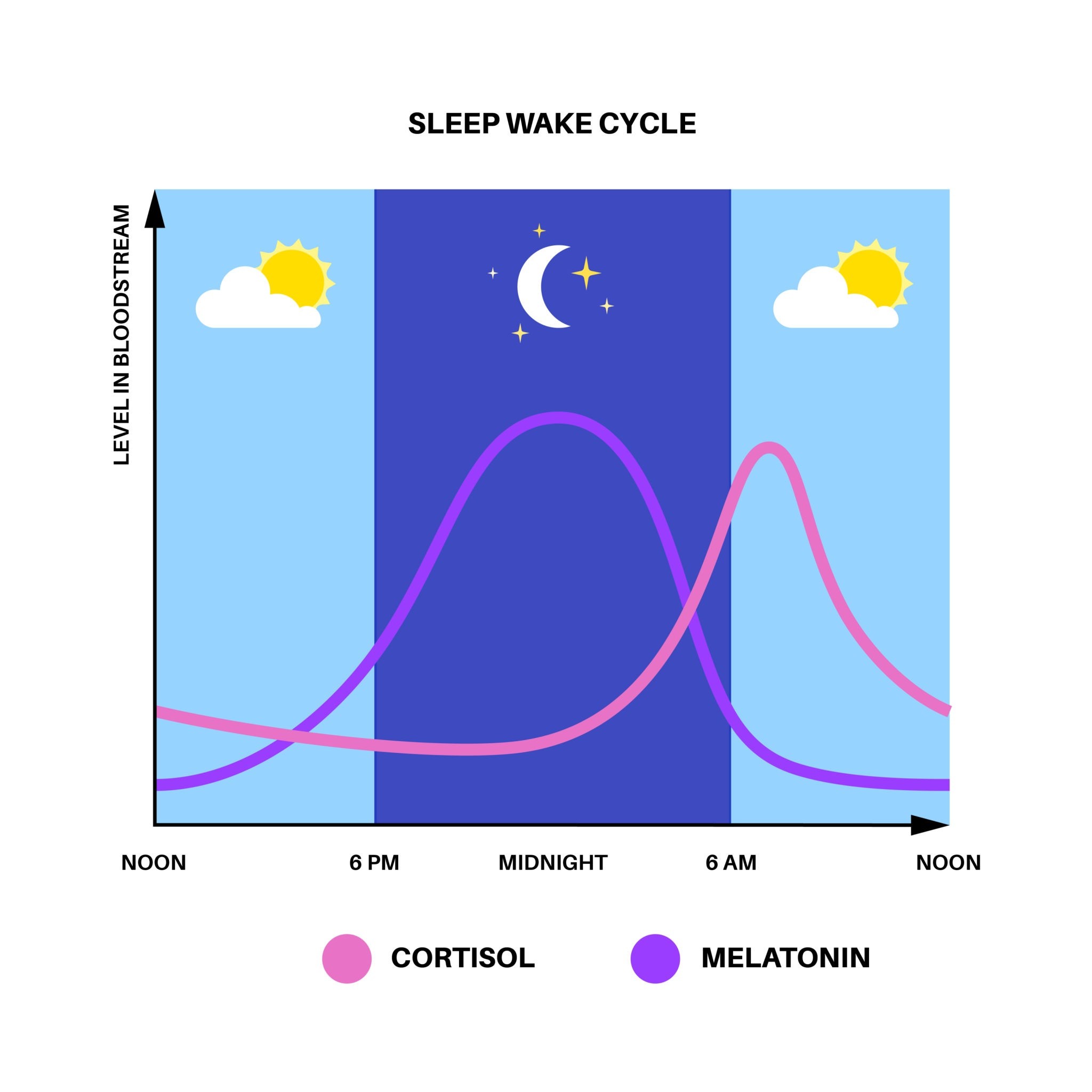
A healthy cortisol curve peaks in the morning and drops at night. Chronic stress flips this, leading to insomnia and mid-day energy crashes.
Because your nervous system is in a heightened state, your body never fully "downshifts." Your sleep stays shallow, and you wake up feeling like you haven't rested at all. This creates a feedback loop: poor sleep raises your cortisol levels even further the next day, which then makes it even harder to fall asleep the following night.
Why "Trying Harder" Only Stalls Your Progress
When we see these changes, our instinct is to push. We sign up for harder workouts, stricter diets, and tighter control. But under chronic stress, these intense inputs act as additional stressors, raising cortisol even higher. Your body becomes less responsive to change because it is already overwhelmed.
Physiology responds to safety and predictability before it responds to pressure. This is why aggressive dieting and intense training often produce zero visible change when your internal stress levels are maxed out.
How to Lower Cortisol and See Real Results
To actually reverse these patterns, you have to convince your nervous system that the "emergency" is over. This doesn't happen through intensity; it happens through consistency and support.
Stable Sleep Timing: Going to bed and waking up at the same time helps reset your internal clock.
Predictable Meals: Stabilizing your blood sugar prevents the "energy emergencies" that trigger cortisol spikes.
Gentle Movement: Swapping high-intensity workouts for walking or slow mobility work tells your body it’s safe to release stored energy.
Reduced Decision Load: Creating routines that remove daily friction preserves your mental energy and lowers background stress.
As cortisol levels settle, the physical shifts follow naturally. The facial puffiness decreases, the midsection inflammation softens, and your energy starts to feel like yours again. You don't need to force the change; you just need to provide the conditions for your body to relax.
The Post Break Up Glow Up Plan is a 12-week roadmap specifically built to quiet that alarm. By stabilizing your physiology and your routines, we allow your body to return to its natural, grounded baseline. It’s how you move from "tired but wired" to a version of yourself that is actually settled.
[Explore The Post Break Up Glow Up Plan]
Want to test the waters first? You can start with my Free 30 Day Glow Up Project [here].